
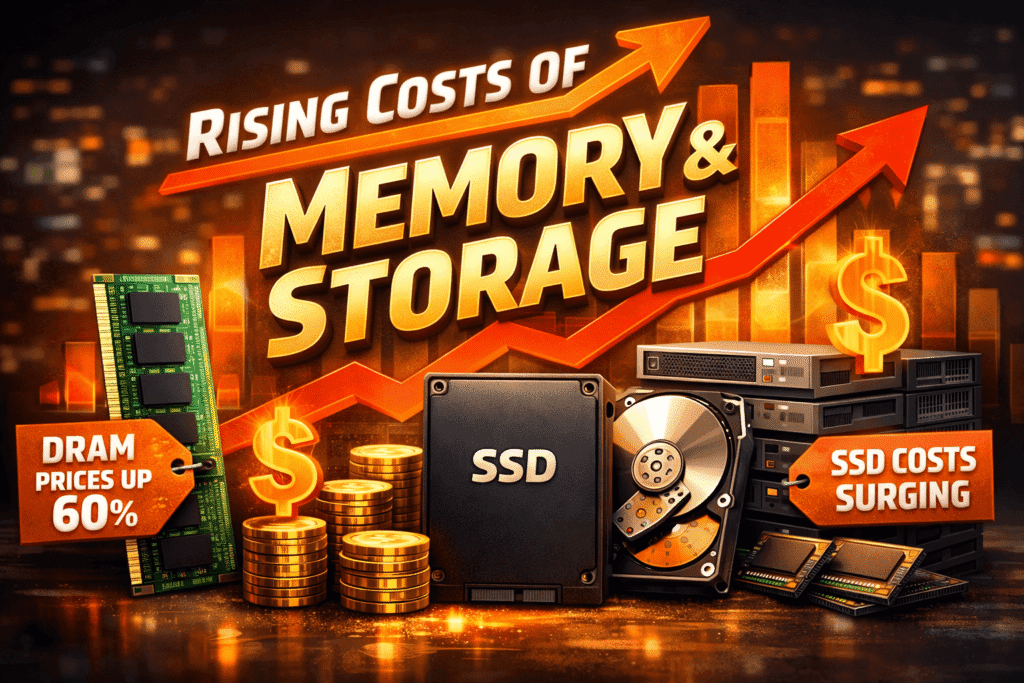
If you’ve priced new desktops, laptops, or servers lately, you’ve probably noticed quotes are higher, “good” pricing expires faster, and lead times can be unpredictable. In 2026, a big driver isn’t just CPUs, it’s the parts that quietly make everything work: memory (DRAM) and storage (NAND/SSD). Driven by intense AI server demand and high-bandwidth memory (HBM) production shifts, prices for consumer memory are expected to remain high due to severe supply shortages.
What’s actually driving the spike this year?
The main driver for the spike in costs can be pointed towards the global memory crunch, caused by large AI infrastructure roll-outs.
The biggest cost pressure in 2026 is memory pricing. AI data centers consume huge amounts of advanced memory (including high-bandwidth memory and server-grade DRAM). As hyperscalers and cloud providers try to lock in supply, the “leftover” capacity for traditional PCs and business servers is getting tighter, so prices are jumping.
Multiple industry trackers are pointing to this: TrendForce raised its outlook for Q1 2026 DRAM contract price increases to ~55–60%, and also lifted NAND forecasts to ~55–60% quarter-over-quarter. The Register reported similar expectations and tied the surge directly to AI-driven demand straining supply. IDC is also describing a “memory crisis” reshaping PC and smartphone pricing and configurations in 2026.
“Normal” business hardware is competing with AI hardware
Even if you’re not buying GPUs, the AI boom still affects you because the same upstream supply chain supports many of the components that go into servers and high-end workstations. Reuters recently highlighted the scale of 2026 AI infrastructure spending, in the hundreds of billions, driving demand for “chips, servers, storage, and networking equipment.” When that much capital moves at once, it compresses availability and raises costs across the board.
Major manufacturers (Samsung, SK Hynix, Micron) have also shifted production capacity toward high-bandwith memory, reducing supply for consumer PC DRAM.
OEMs and distributors are passing through real component costs
When DRAM and NAND move sharply, manufacturers and channel partners react quickly. IT distributors are warning that memory and storage shortages are impacting the channel, noting commentary from HP’s CFO about memory prices rising sharply and continuing through the year. In practical terms, that means server builds with higher RAM footprints (virtualization hosts, SQL servers, line-of-business apps) get more expensive faster than “basic” systems.
Price volatility is worse than a typical “inflation” story
This isn’t a smooth, predictable increase. In a tight component market, pricing becomes jumpy: quotes shorten, substitutions appear, and builds get reconfigured (less RAM/SSD at the same price, or higher prices for the same spec). Vendors may ship devices with less memory and/or storage than buyers are used to as a way to manage rising input costs.
How long will it last?
No one can promise an exact end date, but the best current indicators suggest elevated pricing pressure will likely persist through much of 2026, with conditions improving gradually afterward. This is all assuming capacity expansions catch up.
-
Near-term (Q1–Q2 2026): The sharpest increases are already hitting. Q1 analyst forecasts point to continued pressure, and some vendors believe the shortage is worse than initially expected.
-
Mid-to-late 2026: Expect ongoing volatility. Analysts are pointing to continued market impact through the year.
-
2027: Some easing is plausible, but not necessarily a quick return to 2024 pricing. Experts hope that new production facilities may start to come online giving some relief, but only a modest recovery is predicted in 2027 for impacted device markets. This means costs may remain higher than normal through 2027 and 2028.
What should SMBs do now?
-
Refresh earlier if you’re already planning a Q3/Q4 purchase. Waiting can turn into a “wait tax” when memory/storage prices are moving fast. It may be beneficial to implement any large IT projects sooner rather than later.
-
Correctly size server specs (especially RAM) with a real capacity plan. Memory is often the biggest swing factor.
-
Consider lifecycle strategy: Extend warranty and support on what’s stable and replace what’s risky (aging storage, out-of-support OS, unreliable endpoints).